

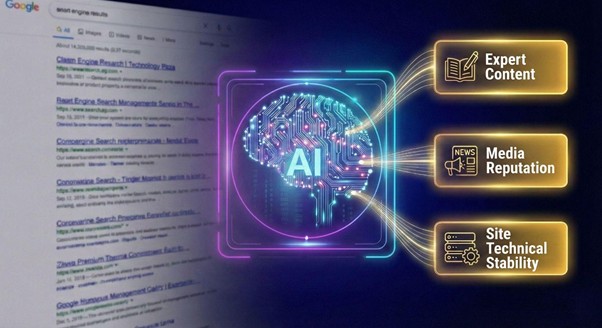
A business’s online presence is changing not because of trends, but because of how users behave. Fewer people scroll through dozens of websites in search results. More often, they receive a short answer or a curated list of recommendations directly within a service interface — in ChatGPT, Gemini, or Google’s AI Overviews. In this environment, simply ranking at the top of Google is no longer enough. What matters far more is whether a company appears credible, clear, and trustworthy.
That’s why the question of how a business can get into AI recommendations goes beyond technical optimization. It’s not about individual settings, but about an overall approach to brand presence in the information ecosystem. Traditional SEO remains the foundation, but without additional steps it quickly stops driving growth. This is where GEO (Generative Engine Optimization) and LLMO (Large Language Model Optimization) come into play — approaches focused on how information is selected, compared, and used in generated answers.
How Recommendation Logic Works
AI-generated recommendations are not built around a single “best” website. They are usually formed from several sources that do not contradict each other and appear reliable when combined. What matters is not only the content of a page, but also the context in which it exists.
In practice, simple factors often make the difference: depth of content, clear structure, demonstrated expertise, stable website performance, and brand reputation beyond one’s own site. This is the same principle behind Google’s generative search. When a topic is covered consistently and supported by external sources, the page has a much higher chance of being used as a foundation for an answer.
GEO Strategy: 4 Key Stages
For results to be sustainable, the process needs to be viewed holistically. A GEO strategy is not a single tool or action. It covers the entire path — from understanding user intent to shaping the final answer the user sees.
1. Query Collection
At this stage, it’s important to move away from classic keyword thinking. Real queries are usually longer, less formal, and often describe a specific situation or problem a person is facing. These formulations are the most valuable for further work.
Instead of individual keywords, it’s far more effective to work with topics and typical questions. This helps build a clear context that naturally forms into answers. At this point, SEO shifts from mechanical keyword selection to a deeper understanding of audience behavior.
2. On-Site Optimization: Content and Technical Foundation
Even strong content won’t perform if the website is slow, unstable, or overloaded. Page speed, logical structure, a properly implemented mobile version, and correct indexing all matter.
At the same time, content must remain reader-friendly. Clear headings, logical paragraphs, direct answers, and formats like FAQs significantly improve clarity. Within a GEO-driven approach, practical value matters more than text length.
3. Off-Site Optimization and Reputation
AI systems evaluate not only the website itself, but also the information environment around it. Where and how a brand is mentioned matters — in industry media, analytical materials, case studies, or professional publications.
External mentions and expert commentary gradually build trust in a source. This is where the difference between traditional SEO and LLMO (Large Language Model Optimization) becomes most visible: the decisive factor is not the number of links, but the quality of validation and the context of mentions.
4. Monitoring and Analytics
This type of promotion does not deliver instant results and cannot be reduced to one-time changes. It’s essential to regularly track which topics the brand appears for in recommendation answers and in what context it is presented.
These insights help refine the strategy: strengthening pages that already perform well and improving weaker areas. Consistent, ongoing work is what allows results to stabilize and avoids short-term fluctuations.
Tools and Resources
In practice, strong results come from solving concrete tasks rather than relying on individual tools. This includes topic analysis, technical site health, and external brand presence.
Special attention should be paid to reputation beyond the company’s own website. Mentions in media, professional communities, and public discussions gradually build trust. It’s also important to understand how the brand appears in recommendation answers from services like ChatGPT, Gemini, or AI Overviews — they typically rely on content with clear logic and accessible presentation.
If a business needs a structured, systematic approach, it may be worth seeking professional support at https://compas.agency/ai-prosuvannya/ — where experts provide detailed guidance.
Example of Results
The video case study below demonstrates how a consistent GEO strategy improves brand visibility even in a competitive niche: https://www.youtube.com/watch?v=q1jJjU-dAY4
Conclusion
Recommendations are not random and not the result of a single tool. They emerge at the intersection of content quality, technical stability, and reputation. Working only with keywords or backlinks is no longer enough for businesses.
Today, AI, generative search, GEO, and LLMO function as a unified system. A comprehensive approach is what allows a brand not only to avoid getting lost among competitors, but to become a source that users — and AI — trust.
About the Author
Artur Kvak is an AI/SEO expert and founder of Compas Agency. He specializes in helping businesses grow within generative search environments https://compas.agency/kvak-artur/.
Leave a Reply