

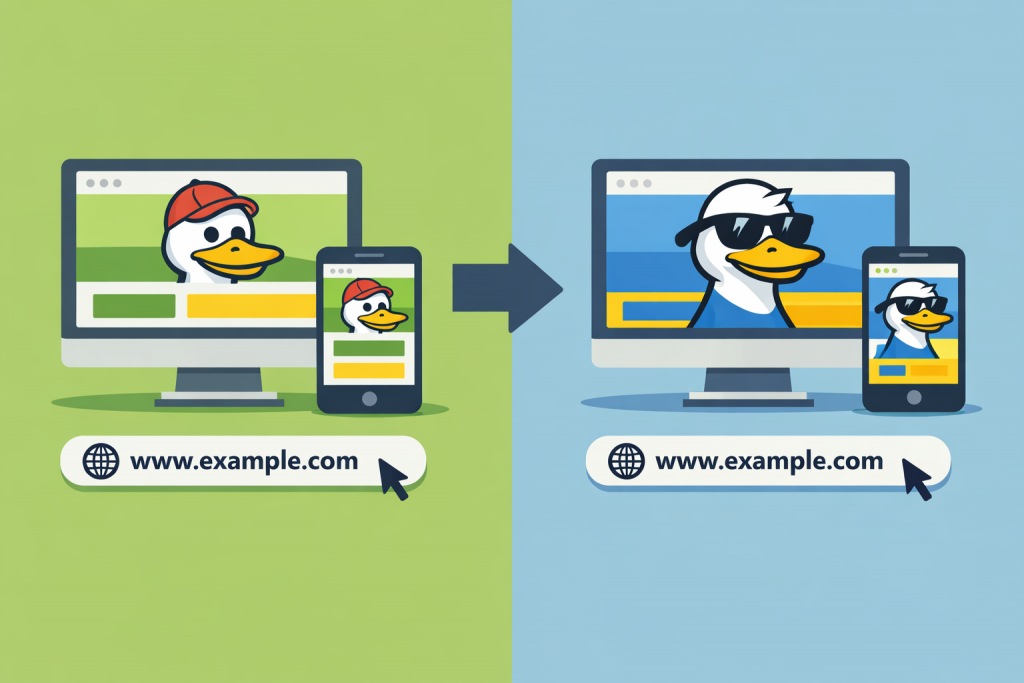
Rebranding is often perceived as a complete reset of a business — a new name, logo, communication style, and even a new domain. However, in practice, changing the domain name is far from always necessary. In many cases, a company can refresh its brand without losing its main digital asset — a domain that already has history, reputation, and user trust. It is important to understand in which situations keeping the existing domain is not only possible, but also a strategically sound decision.
Rebranding as a visual and communication update
The most common scenario is rebranding without changing the essence of the business. A company updates its logo, colors, fonts, and tone of communication with its audience, but continues to operate under the same name or with minimal adjustments. In such cases, the domain remains a logical part of the brand, since it is already familiar to customers and associated with a specific product or service. For users, the domain is a point of entry that creates a sense of stability, so changing it without strong reasons may cause confusion or distrust.
When the brand name remains the same, but the presentation changes
Companies often go through a stage of “maturity” when the initial style begins to feel too simple or outdated. In this situation, rebranding is aimed at raising status rather than changing identity. If the brand name stays the same, the domain does not lose its relevance. On the contrary, it reinforces continuity and shows that the business is evolving rather than starting from scratch. For search engines, this is also a positive signal, since the domain already has indexation, history, and positions in search results.
Product updates without changing the brand
There are cases when a company significantly changes its product or service but does not abandon the brand. For example, it may expand functionality, enter new markets, or change its operating model. If the brand remains recognizable and the domain does not mislead users about the nature of the offering, replacing it is not mandatory. Even if the website content is completely обновлено, the domain itself continues to serve as a familiar reference point for customers.
When the domain already has a strong reputation
A domain is not just a website address, but accumulated digital capital. It includes the trust of search engines, backlink history, media mentions, and user memory. If a domain has been operating for many years and is associated with reliability, changing it during rebranding may cause more harm than benefit. In such cases, it is more reasonable to adapt the brand to the existing domain than to sacrifice a well-earned reputation for the sake of formal alignment with a new style.
Rebranding through clarification rather than name replacement
Sometimes rebranding does not involve changing the name, but rethinking it. A company may begin to interpret its name differently, giving it new meaning or a broader context. If the domain is not tied to a narrow niche and does not limit development, it remains relevant. For users, it is more important to understand what the brand offers today than to see a new website address.
Minimizing risks for business and marketing
Changing a domain is always associated with risks: temporary traffic loss, the need to set up redirects, updating advertising materials, and revising communications. If rebranding does not require a radical change in positioning, keeping the domain helps avoid these problems. The business continues to operate stably, and rebranding is perceived as evolution rather than a sharp break with the past.
When keeping the domain builds trust
For many users, a familiar domain is a marker of security and predictability. This is especially relevant for services related to finance, data, or long-term cooperation. Rebranding without changing the domain signals that the company remains the same legally and operationally, simply becoming better and more modern. This approach lowers the barrier to accepting change and helps preserve a loyal audience.
Balance between renewal and continuity
The main idea of successful rebranding is finding a balance between the new and the familiar. If the domain fits organically into the updated brand and does not contradict its values, there is no reason to change it. In such cases, rebranding becomes a logical continuation of the company’s development, and the domain serves as a stable foundation on which a new stage of the brand is built.
Leave a Reply