

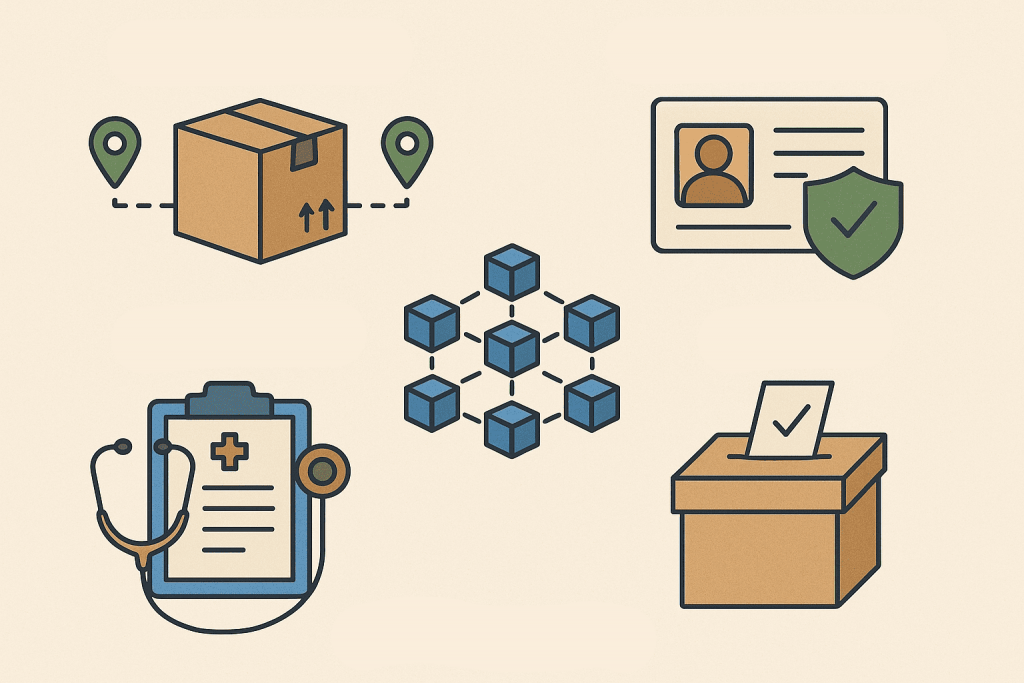
When most people hear the word “blockchain,” they immediately think of Bitcoin and other cryptocurrencies. However, the history of this technology is much broader. Blockchain is a special method of storing information as a chain of blocks, where each block contains data and is linked to the previous one through a complex mathematical code. This makes the system transparent, protected from alterations and fraud. It is important to understand that blockchain itself is not a currency but a tool for reliably storing and transferring information.
Thanks to its unique structure, blockchain reduces the number of intermediaries and increases trust between participants. Even in the early stages of its development, the technology was used beyond finance. Let us look at how and where blockchain was applied at the very beginning outside the sphere of money, and why this was important for the development of other industries.
Documents and Certificates
One of the first non-financial uses of blockchain was storing important documents and certificates. Imagine that every important document — a diploma, certificate, or license — can be recorded in the blockchain. This guarantees that no one can forge or change information after the fact. Such an approach is especially attractive for educational institutions, government bodies, and large corporations where data accuracy and authenticity are critically important.
Another interesting aspect is that blockchain allows documents to be verified without intermediaries. For example, an employer can quickly confirm the authenticity of a diploma without contacting the university. As early as 2013–2014, projects were already using blockchain to verify diplomas and certificates, demonstrating the technology’s ability to increase trust in educational and professional environments.
Supply Chain Management
Another area where blockchain quickly proved useful was logistics and supply chain management. Global supply networks require transparency and accurate tracking of every stage — from production to the end consumer. Blockchain enables recording all transactions and product movements in an immutable chain, significantly reducing the risk of fraud and errors.
Even in the early days of the technology, companies were testing blockchain to track food products, pharmaceuticals, and even luxury goods. For example, one could verify that organic products were indeed grown without chemicals, or that an expensive watch passed all production stages officially. This transparency protected consumers and helped companies optimize internal processes.
Copyright and Intellectual Property
Blockchain was also used to protect copyright and intellectual property. Musicians, writers, artists, and developers could register their works in the blockchain, giving them proof of authorship at a specific date and time. This reduced the risk of illegal copying and simplified the process of proving rights in case of disputes.
This function was especially important for independent creators who did not have large intermediary companies to protect their work. Blockchain allowed authors to track the use of their content and even monetize it more transparently. Already in the early 2010s, startups were emerging that specialized in registering music and digital art in the blockchain, demonstrating the practical value of the technology beyond finance.
Voting and Civic Initiatives
Electronic voting became another example of early non-traditional blockchain use. The technology ensures process transparency and protection from fraud, since each vote is recorded in blocks and cannot be changed afterward.
The first experimental projects in this direction appeared in the mid-2010s for local elections and civic initiatives. These projects showed that blockchain can increase citizens’ trust in the voting process and make participation in decision-making more convenient. Although large-scale adoption is still limited due to technical and legal challenges, the potential of the technology is clear.
Early Experience and Lessons
Early use of blockchain outside finance demonstrated that the technology is not limited to cryptocurrencies. It can enhance transparency, reduce fraud risks, speed up processes, and strengthen trust across various fields. At the same time, these first projects helped developers understand the technology’s limitations: scalability, data processing speed, and energy consumption were key challenges that needed to be solved for wider adoption.
Thanks to these experiments, we now see blockchain developing in many sectors — from medicine to public services, from education to art. And although financial applications remain the most well-known, the true potential of the technology is much broader.
Conclusion
Blockchain is not only the foundation of cryptocurrencies but also a universal technology for secure data storage and transmission. From education and logistics to copyright protection and electronic voting systems — it is already demonstrating its ability to make processes transparent, reliable, and efficient.
And if you plan to launch your own blockchain projects or work with Web3 services, RX-NAME will support you with reliable infrastructure — domains, VPS servers, and SSL certificates that create a stable foundation for modern decentralized solutions.
Leave a Reply