
Not so long ago, space remained a domain for scientific experiments, individual missions, and highly specialized research. The number of satellites in orbit was limited, and their tasks were narrowly focused. Today, the situation is changing fundamentally. Space is gradually turning into a full-fledged environment for mass technologies that affect everyday life on Earth, even if this influence is not always immediately noticeable.
Recent news clearly demonstrates the scale of these changes. China has submitted an application to create a gigantic satellite internet network that involves launching around 200,000 satellites into orbit. The CTC-1 and CTC-2 projects each plan nearly 97,000 spacecraft. For comparison, the Starlink network currently has about 9,400 satellites, and even this number already affects space observation and the work of astronomers. This indicates that the issue is not merely technological development, but the formation of a new technical environment beyond Earth.
From Individual Spacecraft to Orbital Ecosystems
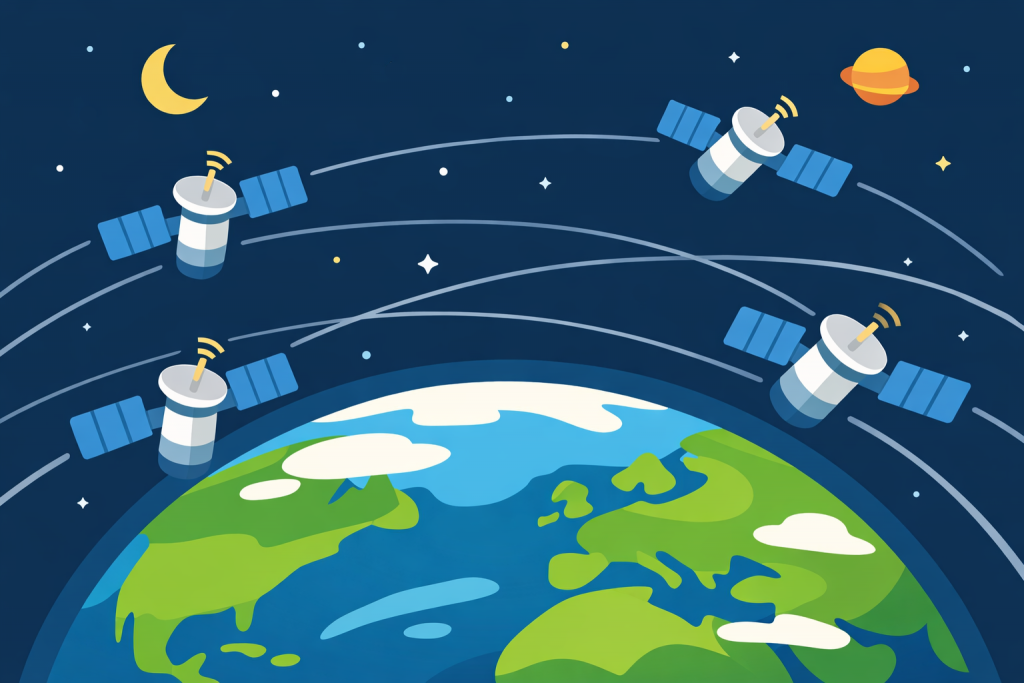
In the past, each satellite was a unique project that took years to develop and cost enormous sums. The modern approach is based on mass production and standardization. Satellites are becoming more compact, cheaper, and functionally simpler, but they operate as part of large networks, where each unit is a component of a unified system.
This is how satellite constellations emerge—orbital ecosystems that provide continuous service. They do not depend on a single spacecraft but function through their quantity and interaction. In this context, plans to deploy tens or even hundreds of thousands of satellites appear to be a logical stage of evolution rather than a one-off technological experiment.
Mass Technologies Beyond the Atmosphere
Mass adoption is the key concept at the current stage of space technology development. Satellite systems are no longer created for a limited group of users. They are designed for global coverage, stable operation, and scalability. In this sense, space becomes another environment in which mass-use technologies are deployed, similar to how the internet once assumed this role.
News about China’s plans clearly shows how rapidly the scale of thinking is changing. If just a few years ago thousands of satellites seemed excessive, today tens of thousands are already viewed as a necessary foundation for the stable operation of global services. This changes the very perception of orbit—it ceases to be a conditionally “empty space” and turns into a densely utilized technological zone.
New Challenges of Mass Space Deployment
Alongside new opportunities, complex challenges also emerge. A large number of satellites creates congestion in orbital space and affects astronomical observations. Experts already note that even relatively small constellations can interfere with the study of deep space. Larger-scale projects will require new approaches to design, orientation, and interaction between spacecraft.
In addition, massive orbital systems demand a high level of automation. Humans physically cannot manage tens of thousands of objects manually, so algorithms for autonomous control and self-regulation play an increasingly important role. This is further evidence that space is becoming an environment for complex technological processes rather than merely a site for launches.
Space as Part of Everyday Technologies
Despite their scale and complexity, space technologies remain invisible to most users. People rarely think about where signals, data, or connections originate. Yet this very invisibility is a hallmark of mass technology. Space is integrating into the familiar digital world so deeply that it is perceived as something self-evident.
Plans to create ultra-large satellite networks demonstrate that outer space is no longer viewed as an exclusive zone for isolated tasks. It is becoming a foundation for new services and solutions designed for long-term, stable operation on a global scale.
What This Means for the Future
The mass освоration of orbit is not a short-term trend but a long-term process. Each year, technologies become more accessible, and projects grow in scale. News about tens of thousands of satellites no longer sounds like science fiction but is perceived as the next stage of development.
The RX-NAME blog regularly features materials on modern technologies, digital trends, and phenomena that influence the development of the internet and the IT sector as a whole. It offers plenty of interesting and informative content for those who want to better understand how the technological world around us is changing.
Leave a Reply