

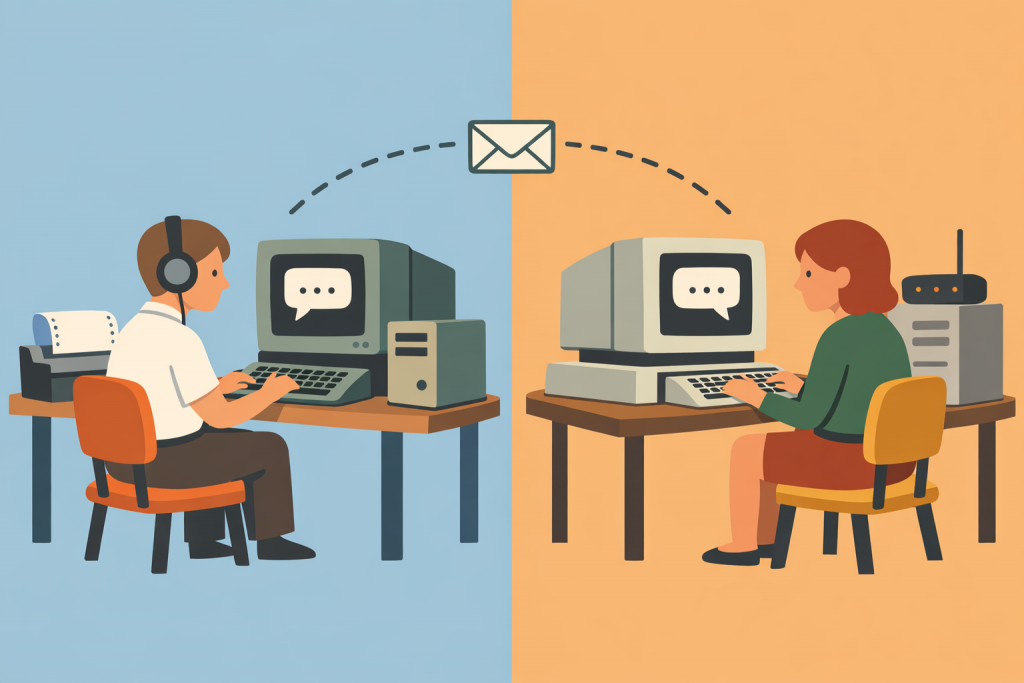
The idea of sending messages over a distance appeared long before computers and the internet. For centuries, people relied on paper letters, couriers, and postal stations. However, with the emergence of computer networks in the second half of the twentieth century, correspondence began to shift into digital form. This period marked the birth of email — a service that later became the foundation of modern digital communication.
How the First Email Appeared
The first prototypes of email emerged in the 1960s as part of large scientific and military projects. At that time, computers were expensive, occupied entire rooms, and were used mainly in universities and research centers. Users worked on a single computer, and message exchange took place between user accounts on the same machine. Essentially, these were digital notes that one system user could leave for another.
A real breakthrough occurred in 1971, when engineer Ray Tomlinson sent the first message between two computers connected via the ARPANET network — the predecessor of today’s internet. It was then that the @ symbol was introduced to separate the username from the computer name. This format proved so convenient that it has remained in use to this day.
How Email Works
Email operates on the principle of message transmission between servers. When you send a message, it is not transferred directly from your computer to the recipient’s computer. First, the message reaches a mail server — a specialized computer responsible for receiving, storing, and delivering emails. Then the sender’s server connects to the recipient’s server and transfers the message.
This process relies on special mail protocols — a set of technical rules that define how computers exchange email. For example, one protocol handles sending messages, while others are responsible for receiving and reading them. For the average user, these processes remain invisible: everything appears as if the message simply arrives instantly in the inbox.
From Local Networks to Global Correspondence
Initially, email existed only within individual networks. Users could correspond only with those connected to the same system. With the development of the internet, the situation changed dramatically. Email became global: messages could now be sent to any part of the world within seconds. This turned digital correspondence into a universal tool for business, education, and personal communication.
Over time, public email services accessible to everyone emerged. They simplified registration, offered convenient web interfaces, and made email a mass phenomenon. At the same time, it became important for companies and projects to have their own email addresses associated with their brand rather than relying on public services.
How Email Is Connected to Domains
This is where domains began to play a key role. A domain is a unique name of a website or service on the internet, such as example.com. In an email address, the domain part comes after the @ symbol and indicates which server stores the mail. For example, in the address info@example.com, the domain example.com determines that messages are processed by the mail system associated with that domain.
Having a own domain allowed companies to create corporate email with any number of addresses, emphasize brand professionalism, and control their mail infrastructure. This became an important stage in the development of digital correspondence, as email turned from a simple messaging method into part of a business’s digital identity.
Digital Correspondence as the Foundation of Modern Communication
Today, email remains one of the key tools in the digital world. It is used for service registration, account recovery, business correspondence, and official notifications. Despite the rise of messengers and social networks, email continues to hold the status of a universal and formal communication channel.
To create custom email addresses for a business or project, a domain and hosting are required — a platform on which the mail server will operate. At RX-NAME, you can register a domain name and choose virtual hosting that allows you to create personalized email addresses on your own domain. This is a convenient step for those who want to build a professional and reliable digital correspondence system for their project or company.
Leave a Reply