

Just a few years ago, artificial intelligence was perceived as an experimental technology available mainly to large corporations, research laboratories, or a narrow circle of developers. AI was associated with research, complex algorithms, and distant prospects. Today, the situation has changed dramatically. Artificial intelligence has become a mass product used daily by millions of people around the world, often without even thinking about it. This shift was not accidental — it is the result of a long-term strategy pursued by the largest technology companies.
From Internal Tools to Global Platforms
For most technology giants, the path to AI began long before it became popular. Back in the 2000s, Google actively invested in machine learning to improve search and advertising. Microsoft used data analysis algorithms in its enterprise products and cloud services. Meta developed recommendation systems for social networks, while OpenAI started as a research organization focused on the safe development of artificial intelligence.
At that time, AI was an internal tool — it worked “behind the scenes” and was not positioned as a standalone product for mass users. However, with the growth of computing power, the reduction in server infrastructure costs, and the emergence of large language models, companies saw an opportunity to bring these technologies to a new level of accessibility.
Scaling as the Key to Popularity
At the beginning of the surge in mass interest in artificial intelligence, OpenAI had an almost indisputable advantage. ChatGPT effectively became synonymous with AI for a broad audience, offering a simple interface and a tangible practical effect in everyday tasks. For a long time, no other service could match this level of recognition and reach, giving OpenAI a significant time and technological lead.
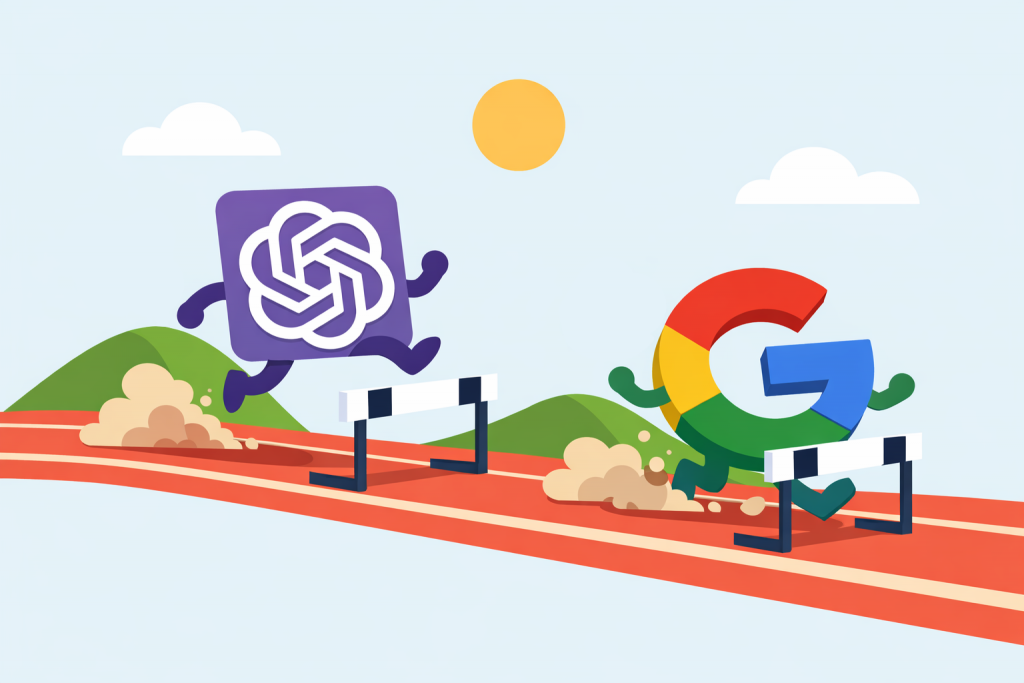
However, as interest in AI grew, other major companies actively entered the competition, most notably Google. Leveraging its own ecosystem, computing resources, and many years of experience working with data, Gemini began to rapidly close the gap. This is clearly reflected in statistics over the past year: ChatGPT’s share decreased from 86.7% to 64.5%, while Gemini grew from 5.7% to over 21%. At the same time, other players — DeepSeek, Grok, Claude, and Perplexity — have established themselves in smaller but stable niches.
These figures do not indicate a loss of relevance for ChatGPT, but rather a shift in the balance of power. OpenAI is no longer the sole center of gravity for users, while Gemini is gradually becoming a full-fledged alternative. Scaling plays a key role here: large companies can quickly deploy AI services for millions of people, integrate them into existing products, and offer users real choice. This process clearly signals that artificial intelligence has moved from the dominance of a single player to a fully developed mass market.
Simplicity Instead of Complexity
One of the main factors behind the mass adoption of AI has been simplified interaction. In the past, working with machine learning algorithms required knowledge of programming and mathematics. Today, a simple text query is enough. Major companies have deliberately invested in user-friendly interfaces that are understandable even to people without a technical background.
This approach has changed the perception of artificial intelligence. It has stopped being a “black box for engineers” and has become a universal digital assistant. As a result, AI is now widely used in education, marketing, business analytics, customer support, and everyday household tasks.
Artificial Intelligence as Part of Server Infrastructure
Another important factor in the mass adoption of AI is its integration into server infrastructure. Today, artificial intelligence is actively used to optimize data center operations, balance workloads, predict failures, and automatically scale resources. Simply put, AI helps servers operate more stably, faster, and more efficiently.
For large companies, this is critically important, as processing requests from millions of users requires effective resource management. Artificial intelligence analyzes traffic, predicts peak loads, and allows infrastructure to be prepared in advance. As a result, users receive fast and reliable services without even realizing that AI is working behind the scenes.
Competition as a Driver of Development
The active growth of market shares among different AI platforms highlights another important trend — competition. Major technology companies can no longer afford stagnation. Every update, every new feature, and every model improvement becomes part of the struggle for user trust.
This competition benefits the mass audience. It stimulates technological development, lowers entry barriers, and accelerates the emergence of new use cases for artificial intelligence. AI is no longer an exotic innovation and is gradually becoming as fundamental a part of digital infrastructure as the internet or cloud services.
The Future of Mass Artificial Intelligence
Today, we are witnessing only an intermediate stage. Major technology companies have already laid the foundation by transforming artificial intelligence from an internal tool into an accessible product. The next step is even deeper integration of AI into everyday services, business processes, and infrastructure solutions.
The mass adoption of artificial intelligence means not only a growing number of users, but also a change in the role technology plays in our lives. AI is becoming an invisible yet critically important part of the digital world, shaped by large companies that combine innovation, scale, and accessibility.
Leave a Reply