

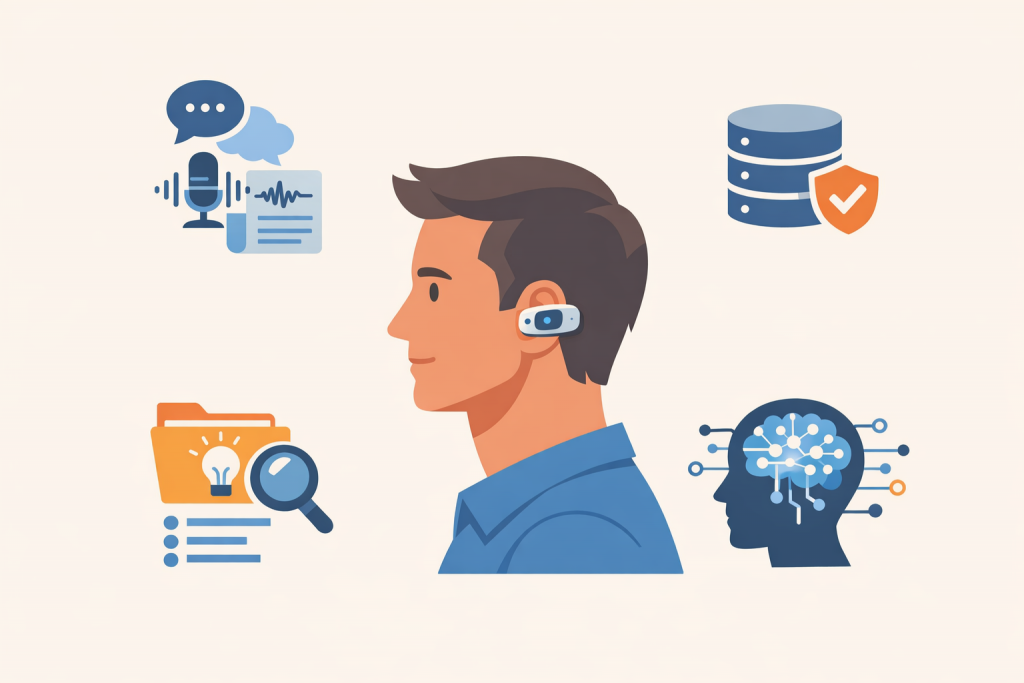
At CES 2026, SwitchBot unveiled a device that many have already called a “second brain.” The small AI clip called MindClip, which attaches to the ear, is capable of recording conversations and spoken thoughts, storing them in a personal database, and allowing quick retrieval of the needed information using artificial intelligence. Essentially, it is an external memory for a person that is always close at hand. This news sparked not only interest, but also a very logical question: are we moving toward a moment when artificial intelligence becomes an extension of human consciousness?
From a tool to a constant companion
Not long ago, artificial intelligence was perceived as a supporting tool. It recommended movies, suggested routes, or corrected mistakes in text. Today, AI is gradually moving to a new level. It does not merely respond to requests, but accumulates context, remembers previous actions, analyzes habits, and adapts to a specific individual. Devices like MindClip make this process even deeper, as artificial intelligence begins to work directly with our thoughts, conversations, and everyday experiences.
Memory as a service
Human memory has always been selective. We forget small details, confuse facts, and remember the same events differently. Artificial intelligence offers a different model — to record everything and store it without loss. This looks convenient, especially in work, education, or business, where it is important not to lose a single idea or agreement. At the same time, a new reality emerges in which memory gradually turns into a digital function, available by subscription and tied to servers and cloud infrastructure.
AI penetrating all areas of life
Today, artificial intelligence is already present almost everywhere. It is used in medicine to analyze images, in finance to detect fraud, in marketing to personalize advertising, and in everyday life — in smart homes and voice assistants. The number of AI services is growing so rapidly that hundreds of new websites and projects related to artificial intelligence are registered worldwide every day. This indicates that AI is ceasing to be exotic and is becoming a basic technology, similar to the internet or mobile communication.
The boundary between assistance and dependence
The idea of a “second brain” looks appealing, but at the same time makes us think about the consequences. If artificial intelligence remembers for us, analyzes for us, and suggests decisions, will we lose the ability to think independently? History already provides similar examples of how convenient technologies changed human behavior. Navigation reduced the need to memorize routes, calculators weakened mental arithmetic skills. With AI-based memory, this effect may be even deeper, since it concerns not only skills, but the very way of thinking.
Consciousness or its digital shadow
Despite all achievements, artificial intelligence does not possess its own consciousness. It does not experience emotions, lacks intuition, and has no inner experience. However, it can become a digital shadow of a person — a reflection of their thoughts, habits, and decisions. In this form, AI complements consciousness rather than replaces it. It removes routine tasks, helps structure information, and frees up time for creativity and strategic thinking.
The future is already here
News about devices like MindClip shows that the boundary between humans and technology is becoming increasingly thin. Artificial intelligence is gradually integrating into everyday life and changing our understanding of memory, knowledge, and experience. Whether it will become a full-fledged extension of human consciousness remains an open question. But one thing is clear: AI has already become an important part of it.
When an idea turns into a project
The active development of artificial intelligence opens opportunities not only for users, but also for those who want to create their own services. If you have an idea for an AI startup, it is important from the very beginning to clearly define its presence in the digital space. That is why domain zones such as .ai are gaining popularity — they immediately shape the correct perception of a project as technological and modern. You can register such a domain for an AI project, in particular, through RX-NAME, choosing a name that will be understandable to an international audience. In a world where artificial intelligence is becoming part of everyday reality, even a domain name ceases to be a minor detail and becomes an element of trust, recognizability, and long-term development.
Leave a Reply