

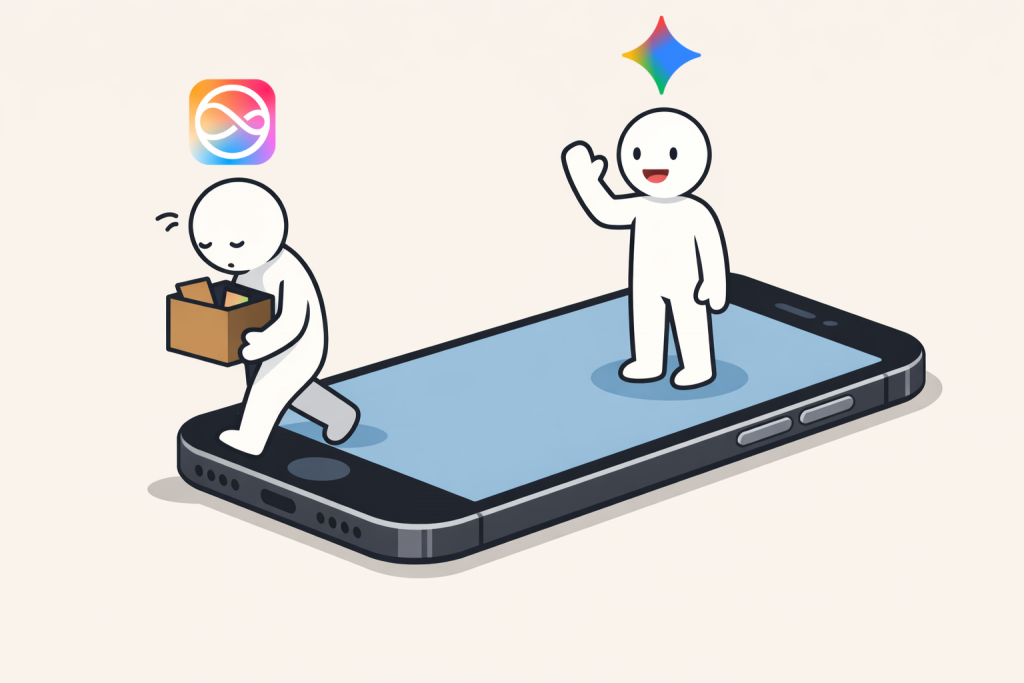
Apple has officially confirmed the integration of Google’s Gemini as the artificial intelligence powering the iPhone. In practice, this means that instead of continuing to develop its own voice assistant, Siri, the company is placing its bet on a third-party, next-generation AI model. For many users, this news may seem like just another ecosystem update, but in reality it points to a much deeper process — the end of the era of classic voice assistants as we have known them.
Why This News Is More Important Than It Seems
Siri was one of the first large-scale attempts to create a digital assistant. Its launch helped shape an entire market for voice assistants, which was later picked up by Google and Amazon. However, over the past few years it has become clear that this concept has largely stopped evolving. Assistants have remained tied to a limited set of commands and predefined scenarios, failing to truly learn how to work with context, complex queries, and long, meaningful dialogues.
Apple’s decision to integrate Gemini is an acknowledgment that further development within the old model is no longer effective. The company is effectively abandoning the idea of a “voice assistant” as a standalone product and moving toward a universal artificial intelligence, where voice is just one of many interaction methods.
The Limitations of Classic Voice Assistants
Traditional voice assistants were built around rigid logic: recognize a command, match it to a predefined scenario, and execute an action. This approach works well for simple requests but quickly breaks down in more complex situations. Any ambiguous phrasing, shift in context, or multi-step question often leads to errors or a refusal to process the request.
Over time, users became accustomed to assistants “not understanding” them and began to perceive these tools not as helpers, but as limited interfaces. This is one of the key reasons why interest in voice assistants started to fade long before the news about Gemini appearing on the iPhone.
Large Language Models Change the Very Approach to Interaction
Unlike classic assistants, large language models operate in a fundamentally different way. They do not rely on predefined scripts but analyze language, intent, and context in real time. This enables true dialogue, the ability to clarify requests, remember previous questions, and adapt responses to a specific situation.
That is why the integration of Gemini is not an “updated Siri,” but an entirely new level of interaction with a smartphone. The user no longer has to adapt to the system’s logic. Instead, the system adapts to the person, their way of thinking, and their manner of expressing ideas.
The Smartphone as an Interface to Artificial Intelligence
Another important consequence of this shift is a rethinking of the smartphone’s role itself. It is gradually transforming from a standalone device into an interface for accessing powerful AI systems that operate on server infrastructure. Computation, data analysis, and model training no longer happen on the phone itself, but in data centers.
This means that the future of personal assistants directly depends on server quality, infrastructure scalability, and the reliability of cloud solutions. That is where the real value of modern artificial intelligence is created, while the voice interface becomes merely a convenient addition.
Why the Era of Voice Assistants Has Ended
Voice assistants will not disappear overnight, but their role is changing fundamentally. They are no longer standalone products and are becoming components of more complex AI systems. The news about Gemini being used on the iPhone clearly shows that the market no longer believes in the evolution of “voice menus” and is instead betting on universal artificial intelligence capable of solving real problems.
This end of an era is not a failure of technology — on the contrary, it is a natural stage of development, where an outdated concept gives way to more flexible and powerful solutions.
AI as the Foundation of New Digital Services
For businesses, this transformation means one thing: future services will be built not around individual features, but around artificial intelligence as a core element. Startups, platforms, and online services increasingly begin their journey by choosing an AI model, server infrastructure, and a clear digital identity for the project.
That is why domain names and technical foundations remain a crucial part of launching any modern AI product. If you are planning to create a service related to artificial intelligence, a domain in a technology-focused zone and reliable infrastructure become just as important as the idea itself. At RX-NAME, you can register a domain for an AI project and lay the right foundation for its future development.
Leave a Reply