

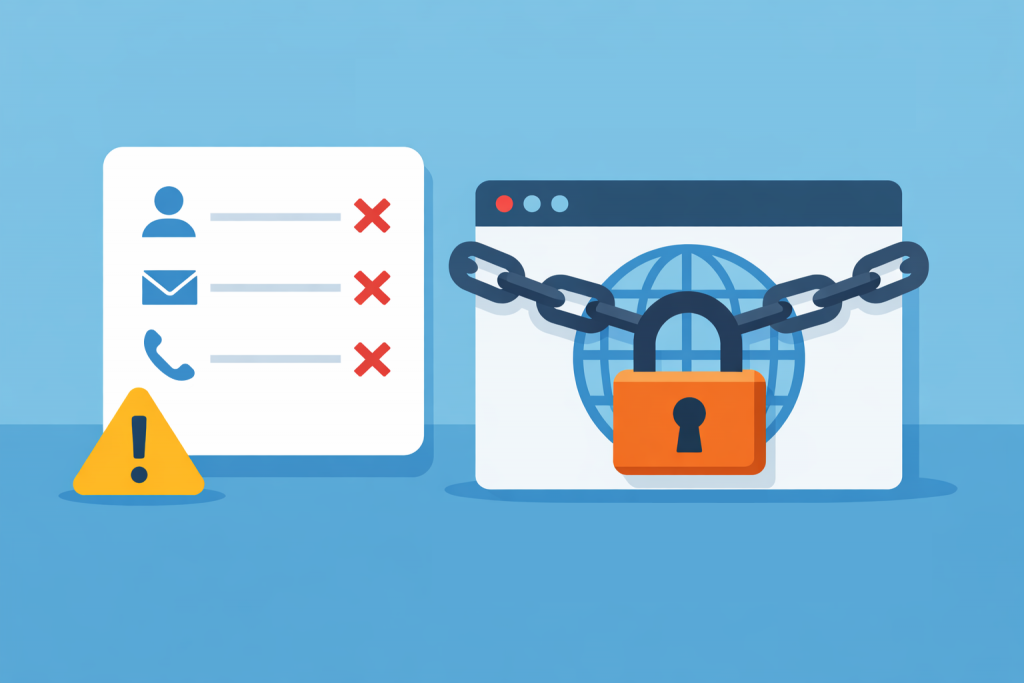
When a domain is registered, the form with contact details usually gets very little attention. The name is checked, the payment goes through – the main thing is that the domain starts working. Fields with the name, phone number or email are often filled in quickly. Sometimes the data is even copied from old accounts or internal documents. The problem shows up later.
Contact information in a domain registration is not just a formality. In practice it is exactly what determines who is considered the owner and who the registrar can contact. If the email address contains a mistake or is no longer used, messages simply do not reach the recipient when they are actually needed. In the domain world this sometimes ends with the domain being placed into a restricted status. The website stops opening, the mail stops working.
Why these details are needed at all
Every domain has a record with the owner’s contact information. It stores a name or company name, an email address, a phone number, a country. Through these contacts the registrar sends service notifications: confirmations of changes, reminders about renewal, sometimes data verification requests. In most cases these are ordinary technical emails that no one really pays attention to. But sometimes those very messages are used to confirm that the domain is controlled by a specific person or company. If there is no response, the system draws its conclusion rather directly.
What mistakes appear in practice
Most often the problem is the email address. For example, people enter an address created “just in case”, or an email on the same domain that has not even been configured yet. The confirmation message arrives, but no one can read it.
There are simpler situations as well. A wrong letter in the address, an old phone number, contact details of a former employee. While the domain works normally, nobody checks these details. They simply remain in the system for years.
Sometimes the situation looks even more ordinary: a company changes the person responsible for the website, but the information in the domain registration is never updated. A few years later it becomes difficult to understand who actually has access to the contact email.
How contact verification works
For international domain zones there is a standard procedure for verifying contact information. After registration or after data changes, the system sends an email with a link. It needs to be opened and the link has to be followed. Usually a few days are given for this. If the confirmation does not happen, the domain is considered unverified. These rules apply in most domain zones and are related to ICANN requirements.
What happens when the data is not confirmed
If verification is not completed, the domain may be moved to a restricted usage status. For users this looks quite simple: the website stops opening and the email stops receiving messages. The owner usually does not find out immediately. At first there are odd symptoms. For example, clients say the website does not open, or emails bounce back. After checking the domain it turns out that the cause is not technical at all.
Why recovery may take time
Even after the contact details are corrected, the domain does not always return to normal operation immediately. The information has to pass verification again, after which the registrar changes the domain status in the registry. Usually it does not take long, but it is not instant either. During this period the website may remain unavailable and email does not work. For a commercial site this is already a noticeable problem.
Why contact details should be monitored
Contact information in a domain often looks like a secondary detail. In reality it serves as confirmation of the right to the domain. All important messages come through it, and it is exactly what is used for verification. Because of that a single small mistake – an incorrect address or an outdated contact – can be enough for the domain to end up blocked at some point. And then it becomes clear that the email field filled in several years ago was actually one of the most important ones.
Leave a Reply