
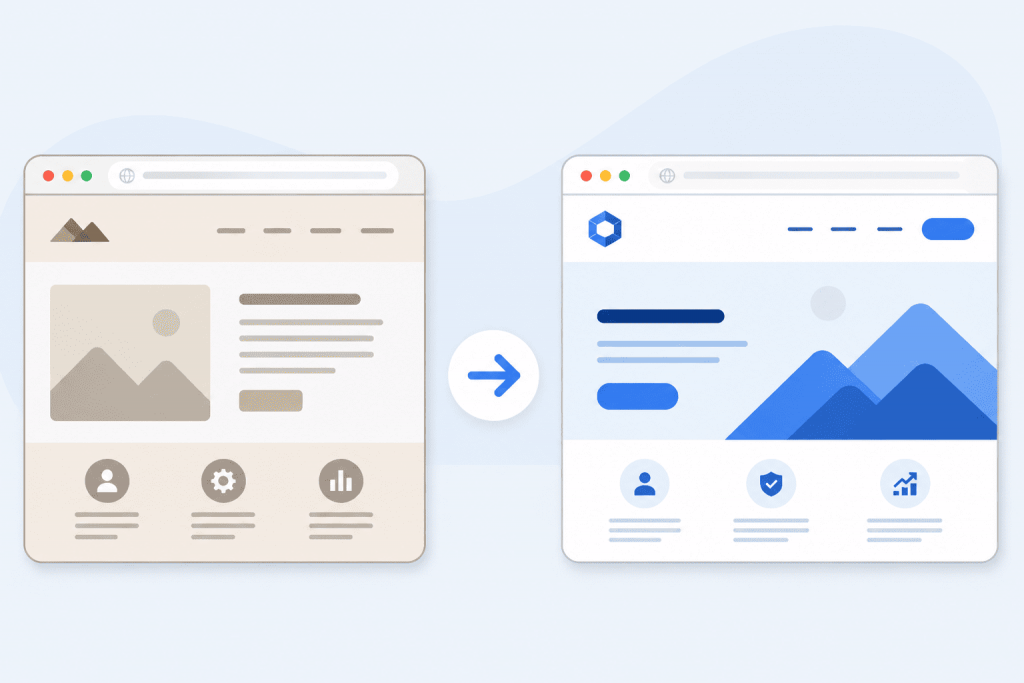
Rebranding is often seen as a complete restart: a new name, a fresh logo, a different tone of communication, and a move to a new website. It seems logical to leave everything old in the past, but this rule does not work with a domain. An address that served as an entry point for years is not just a line in a browser, but the digital history of a business, and it should not be cut off in a single day.
Even if a company has completely changed its identity, the old domain keeps its connection with customers and search engines. It is reputation, accumulated through links, browser bookmarks, and the history of interaction. Simply giving it up means voluntarily handing over part of your audience.
Brand memory and audience habits
When a business works at one address for years, it becomes part of the customer’s everyday routine. Links to the website remain in work chats, old invoices, contracts, or presentations. Even after the official announcement of a name change, people will still enter familiar characters out of habit.
This is critical for companies with a long sales cycle. A client may have received an offer six months ago, and today finally decided to follow the link. If they see a “page not found” error, the conclusion will be quick: the company has closed. In the best case, they will go looking for you on Google, in the worst case, they will simply open a competitor’s website. In this situation, the old domain works as insurance that gently redirects “late” users into the new reality of the brand.
What happens when control is lost
Refusing to renew a registration is always a risk. As soon as the rental period expires, the domain becomes available to anyone. It may be bought by a competitor, a domain investor, or, much worse, the owner of a spam farm.
The problem is that for the outside world this domain is still associated with you. If aggressive advertising or questionable content appears at your former address, the user is unlikely to look into the subtleties of registration rights. The negative impression is automatically transferred to the former owner. A separate aspect is corporate email. Even if you have changed addresses to new ones, partners may continue writing to old mailboxes. Losing the domain means that you no longer control these incoming flows, which creates a gap in security and communication.
The SEO component: not losing what has been built up
In search engine optimization, age and history matter. Over the years, media, partners, and clients have linked to your website. All these connections form the “authority” of the resource in the eyes of search engines.
If you simply close the old website, these links will lead nowhere. The correct technical solution is to configure a 301 redirect. This is a signal to Google that the content has not disappeared, but has moved. In this way, it is possible to transfer part of the accumulated value to the new domain, which allows it to reach high positions faster. Without this, the new website effectively starts its journey from zero, which in competitive niches can cost months of work and large budgets.
Navigation for the user
Rebranding cannot be carried out everywhere instantly. Old links remain in YouTube video descriptions, PDF instructions, printed business cards, or archives of news websites.
The old domain becomes a “backup entrance” that makes the transition less painful. The user does not need to know about your internal changes – they simply want to receive a service. When the transition from the old address to the new one happens automatically or is accompanied by a short explanation, it looks like a professional approach to service. A browser error instead of a website is always a blow to trust.
Use cases and timeframes
Most often, a “silent” redirect is used, when each page of the old website leads to the corresponding new page. Another path is to create a transition page where the brand explains: “We have updated, now we are here.” This is appropriate if the name has changed radically and clients need context so they do not feel disoriented.
The question of how long to keep the old domain usually comes down to economics. However, the cost of annual renewal is usually tiny compared to the risks. Specialists advise keeping control over the address for at least several years after the move. Links on the web live for a long time, and people’s habits live even longer.
A domain after rebranding is not ballast, but a tool for preserving stability. It is a way to protect reputation and guarantee that years of building the brand will not be nullified because of one technical refusal.
Leave a Reply