

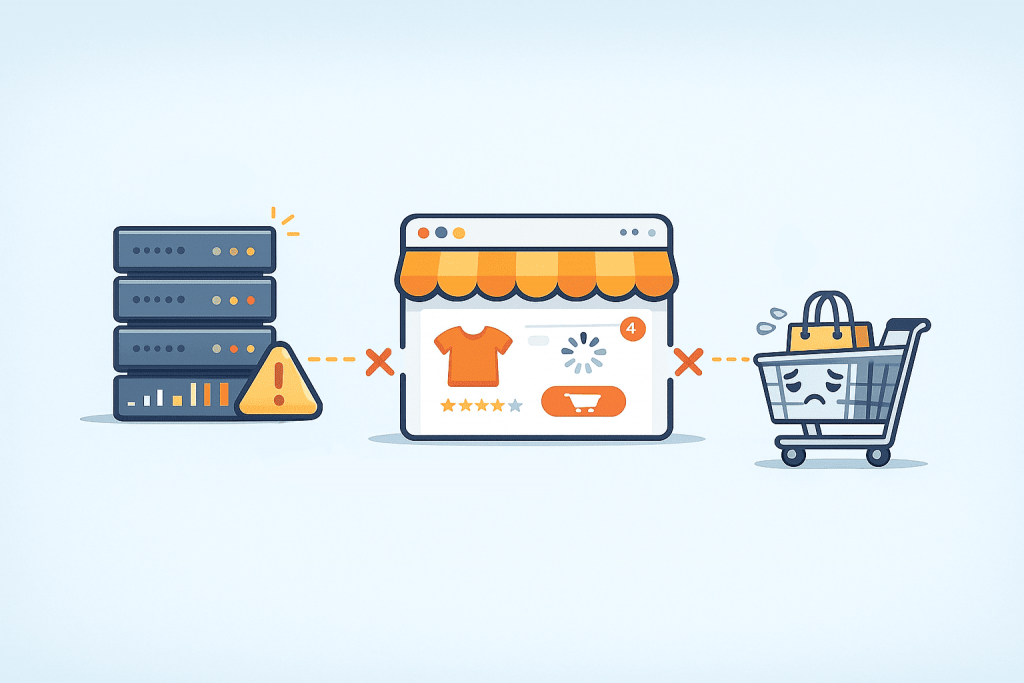
Shared hosting is usually the first choice when launching an online store. The reason is simple: it is affordable, does not require technical expertise, and allows you to get a website online quickly. For small projects or test versions, this seems like a convenient solution. However, an online store is not just a website with text and images. It is a complex system that constantly works with a database, processes orders, payments, shopping carts, customer accounts, and integrations with third-party services. This is where the limitations of shared hosting begin to appear.
How shared hosting works and what its limitations are
Shared hosting is a hosting model in which one physical server is divided among dozens or even hundreds of websites. All of them use shared resources such as CPU, RAM, and disk subsystem. For simple business websites or blogs, this is usually sufficient. But an online store generates significantly more load. Every product view, catalog filter, or checkout process is a database query that requires resources. On shared hosting, these resources are not guaranteed, and the performance of one site can depend on the activity of others.
Performance and page load speed issues
The speed of an online store directly affects sales. If pages load slowly, users simply leave for competitors. On shared hosting, situations often arise where a site works fast in the morning but starts slowing down during peak hours. This happens because server resources are distributed among all clients. Even if your store is well optimized, it can suffer due to neighboring projects that consume too many resources.
Limited control over server settings
Online stores often require specific configurations. This may include a certain PHP version, special caching modules, advanced database parameters, or security settings. On shared hosting, access to server-level settings is usually limited. The store owner is forced to work within a standard environment that does not always suit a particular CMS or e-commerce platform. As a result, project development is constrained by technical limitations.
Security concerns for online stores
Security is critically important for an online store, as it handles customers’ personal data and often payment information. On shared hosting, websites are physically located on the same server. Although hosting providers use isolation mechanisms, the risk remains higher than with more autonomous solutions. A vulnerability in one site can theoretically affect others. For a store, this means increased risks of data leaks or service downtime.
Scaling challenges as the business grows
Even if an online store starts with just a few products and a small audience, it grows over time. New categories appear, marketing campaigns are launched, advertising traffic increases, and seasonal sales peaks occur. Shared hosting is poorly suited for such growth. Increased load often leads to unstable website performance or the need to urgently migrate to another solution. Such a move at a critical moment can cost a business customers and revenue.
Why an online store needs a more flexible environment
An online store is a business tool, not just a web page. It needs predictable performance, control over resources, and the ability to adapt the server to its specific needs. Shared hosting is designed for mass and simple websites, where these requirements are not critical. For commercial projects, it often becomes a compromise that works only at the initial stage.
When it is time to consider alternatives
As soon as an online store starts generating stable income or plans active growth, the limitations of shared hosting become noticeable. Slow performance, security challenges, and the lack of flexible server configuration begin to affect business metrics. This is exactly the moment when it is worth considering solutions that provide more control and stability.
Summary
Shared hosting can be an acceptable option for launching a simple website or a test online store. However, for full-scale e-commerce, it has too many limitations. An online store requires stable speed, reliable security, and the ability to scale. Using shared hosting for such a project often means constantly balancing convenience against risks that become increasingly tangible over time.
Leave a Reply