

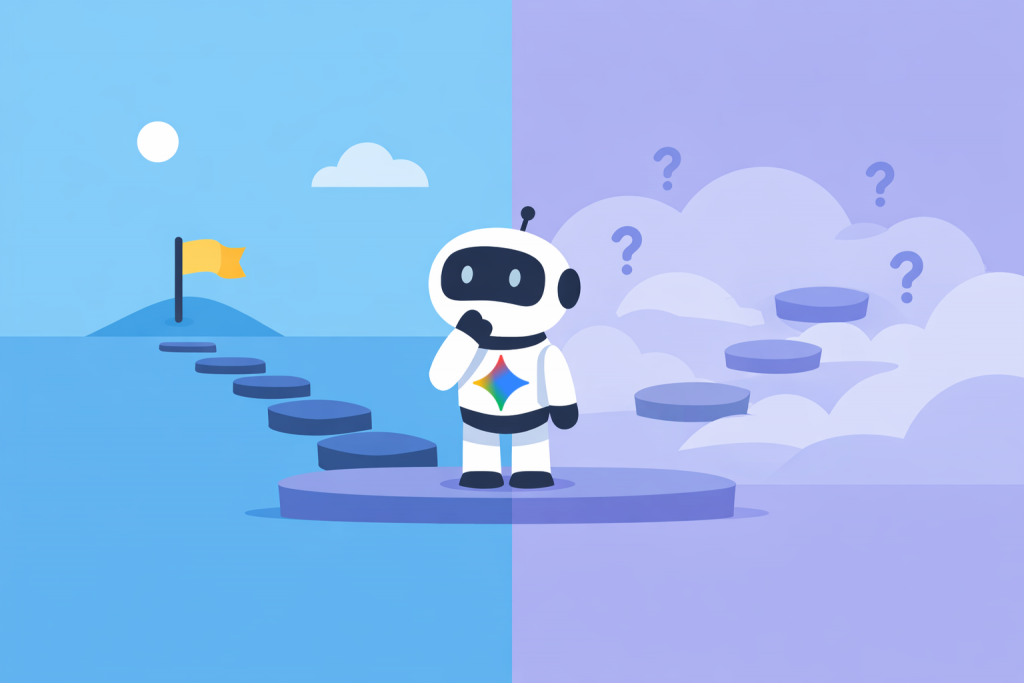
Just a few years ago, most digital systems felt comfortable only in controlled environments. There are clear rules, a defined set of acceptable data, an expected outcome. An online form, a payment module, a CRM with predefined logic – everything works as long as the user stays within the сценарий. As soon as a non-standard request appears or the information is incomplete, the system starts “asking for clarification” or simply makes an error.
Uncertainty for a long time was something handled by people. Managers made decisions without the full picture, analysts worked with fragmented data, engineers tested hypotheses on the fly. Algorithms mostly reproduced what they had already seen. Now that boundary is shifting.
The release of Gemini 3.1 Pro is not just another update in the lineup. There is a visible attempt to teach the system to operate where there is no ready-made template. Not to speed up the answer, but to change the way it is formed.
From repetition to building connections
The classic approach is simple: find the closest example and reproduce the answer. In customer support this works perfectly. In analytics – as long as the data remains typical. But when a new combination of factors appears, for example a sudden change in user behavior or an unusual correlation of metrics, copying past experience no longer helps.
In the ARC-AGI-2 benchmark the model demonstrated 77.1% compared to 31.1% in the previous version. This test is specifically designed for tasks that were not present in the training data. The difference is not decorative. It means the system guesses less by analogy and builds more internal logic.
In real conditions this feels different than it looks in numbers. When the model receives an incomplete process description or conflicting constraints, it does not reduce everything to the nearest template but tries to assemble the structure of the problem from scratch. Sometimes it makes mistakes, but no longer in such a mechanical way.
Uncertainty as a normal operating mode
In strategic planning or risk analysis there is almost never a complete data set. Some information arrives late, some is inaccurate, some is simply missing. People work with assumptions. Digital systems used to require precision.
Gemini 3.1 Pro shows a different approach: multi-step reasoning that takes intermediate results into account. The model can restructure its logic if the query conditions change. It does not look like “magic.” More like the ability to hold several hypotheses in parallel and gradually narrow the solution space.
In the APEX-Agents test, the efficiency of long-term professional tasks almost doubled. For agent-based systems this is critical: the process unfolds over time, and an early mistake can cost the entire outcome. The system must not only execute an instruction but adjust it along the way.
When visualization becomes part of thinking
It is also worth mentioning the ability to generate complex SVG graphics from a text description. At first glance – a convenient feature for designers. In reality it is more about working with abstract structures.
When a diagram is created alongside reasoning, it stops being final decoration. It helps reveal where the logical gap is, where there is an extra link, where data conflicts. In complex technical or business scenarios, this kind of visualization often exposes a problem earlier than textual analysis.
Context as a working resource
A context window of up to one million tokens is not only about “more text.” In practice it means the model can keep a large body of documentation in focus, track change history, follow several parallel discussion threads. Without constant compression and loss of detail.
When working with uncertainty, the connections between fragments determine everything. A single fact may look random. In a broader context it changes the interpretation of the entire process. The more the system can retain simultaneously, the less it simplifies the picture.
Technologies as an analytical partner
Gemini 3.1 Pro does not lead in every text ranking and does not always show the highest results in programming. But its strength lies in handling complex, atypical scenarios. Situations where there is no clear answer and a reasoning path has to be built.
This shifts the role of digital tools. They gradually move from a “find the correct answer” mode to a “help figure it out” mode. In that shift, uncertainty stops being a weak point.
In practice, such models are especially relevant in environments with large data volumes and complex product logic. Infrastructure begins to play a different role as well. Platforms like RX-NAME, where domain, hosting and server solutions are combined, become more than just a place to host a website. They turn into a foundation for tools that deal with uncertainty every day. And this process is only beginning.
Leave a Reply