

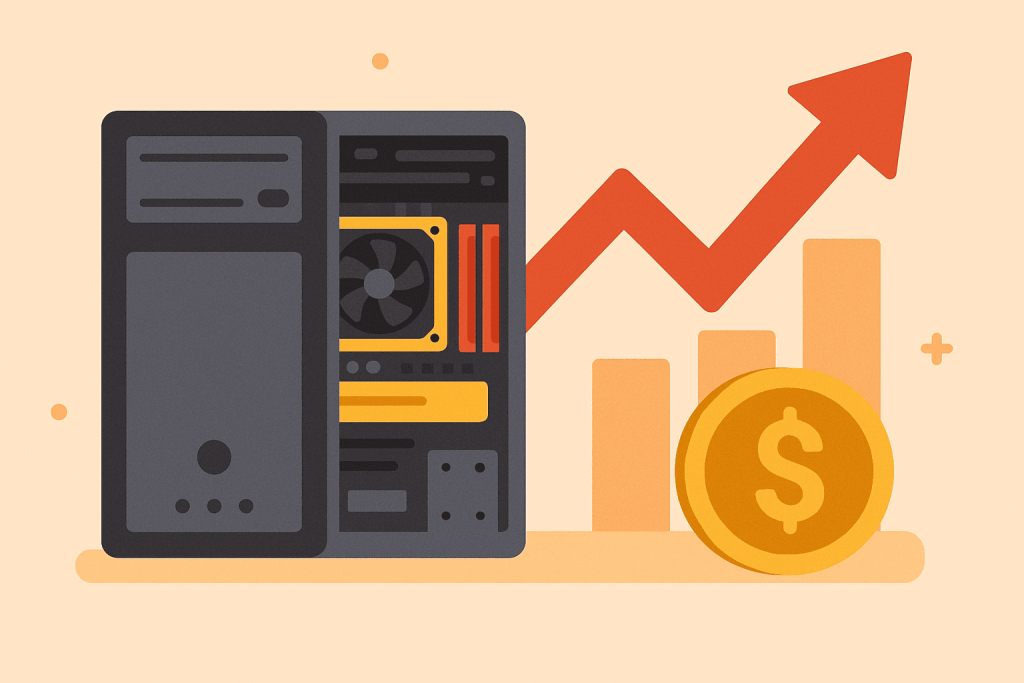
In the coming years, building a personal computer may become significantly more expensive than we are used to. The reason is a global shift of production capacity toward artificial intelligence. Major companies that previously supplied the market with RAM, storage devices, and GPU chips are now redirecting their manufacturing to meet the needs of data centers and AI models. All this creates a shortage of components and leads to rising prices.
Why Memory Manufacturers Are Switching to the Artificial Intelligence Market
Artificial intelligence requires enormous amounts of RAM and specialized memory. The most valuable type is the so-called HBM (High Bandwidth Memory) — ultra-fast memory used in powerful computing systems for training AI models. HBM production lines are expensive and complex, which is why Samsung and SK Hynix — together controlling over 70% of the global memory market — are focusing specifically on it instead of standard modules for home PCs.
Regular DDR5 RAM (Double Data Rate 5) is also becoming scarce. DDR5 is a next-generation RAM standard used in modern computers. It is produced on the same factories that manufacture the more expensive memory for AI. As a result, manufacturers openly state that they do not plan to increase the output of affordable consumer memory, as high-end modules for data centers generate significantly higher profits.
The situation is further intensified by Micron’s decision. The company announced that starting in 2026, it will completely stop producing consumer RAM and SSDs under the Crucial brand. All resources will be redirected to manufacturing memory for AI centers. This means that one of the key suppliers of regular RAM is simply disappearing from the market.
SSD Prices Are Rising Faster Than RAM
An SSD (Solid State Drive) is a solid-state storage device that holds the user’s data — the operating system, files, games, photos. It is based on NAND, a type of flash memory capable of storing information without power. Such drives are much faster than old HDDs (Hard Disk Drives).
NAND memory is also used massively in data centers that host AI models. Demand for storage is growing explosively, so NAND manufacturers are also not increasing production for regular consumers. This makes SSDs one of the fastest-rising components in terms of price.
In wholesale purchases, NAND prices have already increased by tens of percent, and this trend will inevitably reach retail stores.
Graphics Cards May Become More Expensive Than Ever
Modern graphics cards use specialized GDDR (Graphics Double Data Rate) memory. It is designed for high-speed work with graphics, gaming, and 3D computations. But unlike standard RAM, it is more complex to manufacture and is also in short supply.
As GDDR becomes more expensive, GPU manufacturers are forced to raise prices.
AMD has already officially informed its partners about price increases for GPUs (Graphics Processing Units). NVIDIA took an even tougher step: the company stopped selling GPU chips bundled with memory. Now GPU board manufacturers must buy GDDR separately — and at higher prices. This increases the production cost of every graphics card, and therefore the final price for the consumer.
Why Processors Are Also Getting More Expensive
A processor, or CPU (Central Processing Unit), is the main computing element of a computer. At first glance, it is less dependent on the AI boom. But rising costs of production lines, logistics, raw materials, and general market shifts in microelectronics also affect its final price.
AMD has already raised prices for its Ryzen processors — including the new Ryzen 9000 lineup as well as older models. No official explanation was provided, but experts believe that manufacturers are simply adapting to a market where all components are becoming more expensive.
It is expected that Intel will not stay on the sidelines.
When to Expect a Return to Affordable Prices
Analysts from TrendForce and Citi forecast that a return to “normal prices” may be possible no earlier than 2027–2028 — and even that is considered an optimistic scenario. Prices will stabilize only when manufacturers expand production capacity and the demand for AI-focused memory evens out.
For now, all factors point in the opposite direction: demand continues to grow, while component shortages persist. This means that building a PC in the coming years will be expensive and difficult to predict.
How to Reduce Costs Right Now
If you planned to upgrade or build a PC — now is the best time. The longer you wait, the more expensive the necessary components will become, especially RAM and SSDs, which are rising in price the fastest.
An alternative to buying your own expensive hardware may be renting servers or VPS — virtual private servers that run on professional infrastructure and do not require users to purchase costly components. RX-NAME offers VPS and server solutions optimized for stable operation and high workloads. This allows you to get power and performance without overpaying for scarce hardware that continues to grow in price.
Leave a Reply