

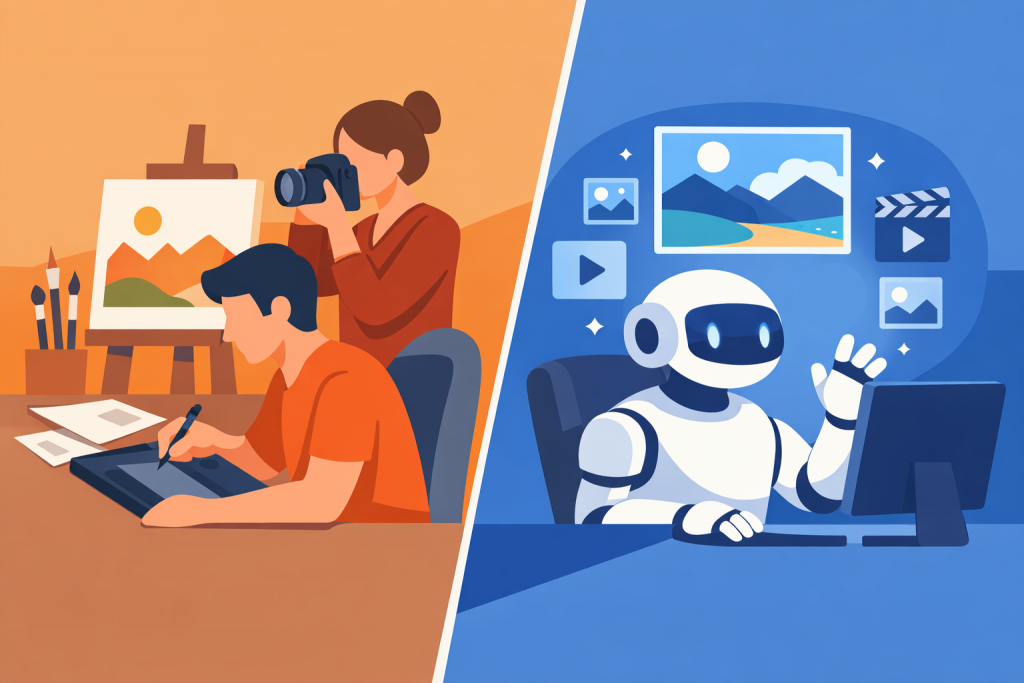
Just a few years ago, generating images with artificial intelligence looked more like a technical curiosity. The models could already draw pictures from a text description, but the result was… let’s say unpredictable. People with six fingers, strange proportions, objects appearing where nobody asked for them. It was interesting to look at. Using it in real work – not really.
Now everything looks different. One of the recent examples is the new image generation model Nano Banana 2 from Google. It works faster, supports resolutions up to 4K, and can keep the same character consistent across different scenes. On paper this sounds like another technical update. In reality, though, things like this change the process of creating content itself. And not only for designers.
Illustrations are no longer prepared for weeks
Earlier the process was fairly predictable. If a picture was needed for a publication, either a photo was searched in a stock library, or a designer created graphics. Sometimes it was a collage, sometimes a full illustration. In any case it took time.
This was especially noticeable in editorial teams working with news or technology topics. The text is already finished, the publication needs to go live today, but there is no decent image. The search for something “roughly suitable” begins. Sometimes that search takes more time than writing the text itself.
With generative models this stage has started to shrink. Instead of searching for an image, a short description of the scene is written. It is called a prompt. In practice it is simply text explaining what exactly should appear in the picture. Within a few seconds the system shows several options. Usually one of them works. Sometimes the description needs a small adjustment, but in any case it is faster than traditional search or creating something from scratch. In many editorial teams this is already a normal part of the workflow. Especially where new materials appear every day.
There are now far more images on the web
Once creating images became easier, people started using them more often. This is clearly visible in blogs, news media, and even on small corporate websites. Materials that previously appeared without illustrations or with one image for the entire text now often have several. Sometimes a separate scene is added almost to every subsection. These are not always complex illustrations. Often it is just a visual situation that helps explain the topic faster.
This is especially noticeable in technology articles. Previously a piece about a new service might consist of text and a few screenshots. Now it is easy to add a conceptual scene showing how the system works, or an illustration of the idea itself. Sometimes it looks natural. Sometimes a little excessive. Still, the fact remains: the amount of visual content on the internet has grown significantly.
What is happening to server infrastructure
There is another side to this story, less visible to ordinary users. Generating images is a fairly heavy task in terms of computation. To create a single picture, the model runs through thousands of mathematical operations. And all of that has to happen in seconds. These calculations work best on GPUs – graphics processors. At first they were mostly used for video games, but over time it became clear that they are even better suited for artificial intelligence workloads.
When millions of users start generating images through services like Gemini or other AI platforms, the load on servers grows very quickly. Each request is a separate computational task. If there are thousands or hundreds of thousands of such requests every hour, the infrastructure has to match that scale. This is why large technology companies are actively building new data centers and purchasing GPU servers. Without this layer of infrastructure, large-scale content generation simply would not work. In a certain sense, the popularity of generative models is already influencing how the internet itself evolves.
Another problem appeared
Once generation became widespread, another question emerged. The origin of images. Previously most images online were photographs or designer graphics. Their origin was more or less understandable. Now an image can be created in literally a minute, and it can look convincing. Because of this, technology companies have started adding special markers to such files.
In the case of Google’s newer models, the SynthID technology is used. It is a hidden digital watermark – a technical marker that indicates the image was generated by artificial intelligence.
At the same time the C2PA Content Credentials standard is developing. Several large companies support it, including Google, Adobe and Microsoft. The idea is simple: the file receives service information about its origin. Where it was created, whether it was edited, what tools were used. For a user this is almost invisible. For platforms and editorial teams it is already important.
Generation is becoming an ordinary tool
If you look at the development of modern services, one tendency becomes noticeable. Content generation is no longer a separate tool. In new versions of Google products, image generation works directly inside Gemini. It gradually appears in search, in Google Lens, and in tools for creating video. In other words, the user no longer switches to a special service. The image appears where it is needed. While working with text, while searching, while preparing a publication. The illustration stops being a separate production step. It simply appears during the process.
It seems that this is the direction the internet is moving toward. Content is increasingly created on the fly – text, images, sometimes even video. The boundaries between tools are slowly dissolving. And models like Nano Banana 2 show quite clearly that this is only the beginning. What not so long ago looked like an experimental technology is gradually becoming a normal part of working with information on the web.
Leave a Reply