

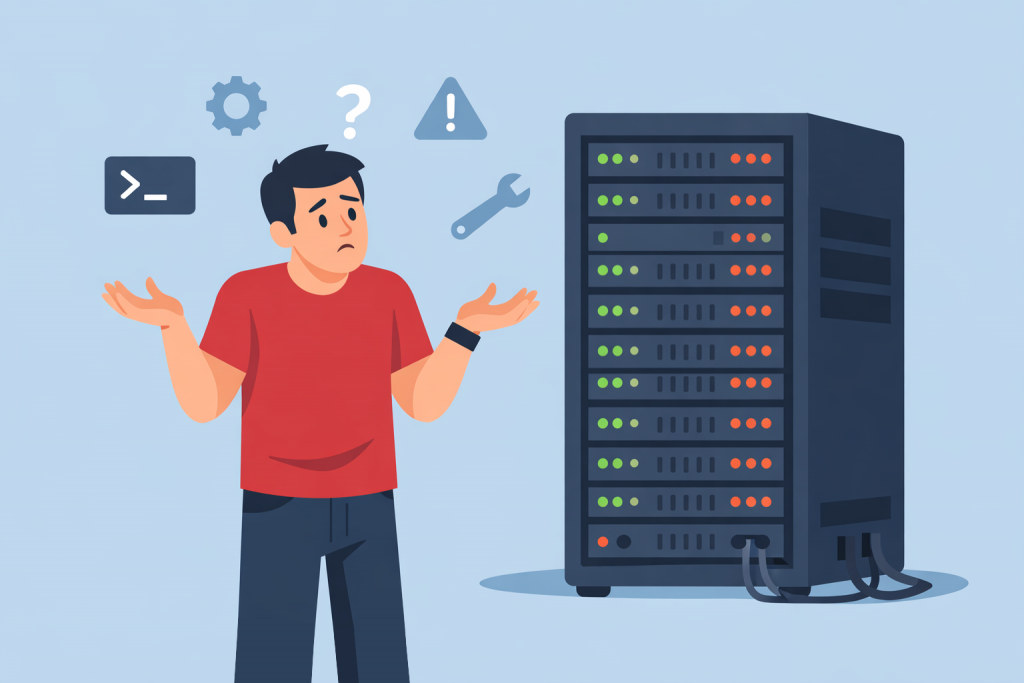
People usually start thinking about moving to a dedicated server not because everything is going great. This is not a story about “we want more control”, but about the moment when the site begins to suffocate. Yesterday everything was still holding on with a VPS, and today – peak hours, the database has grown, cache no longer saves the situation, and any traffic spike immediately shows up in the logs.
A physical machine in a data center is already a different level. No one nearby “eats” your CPU, no one affects read and write speeds. But вместе with this isolation, part of the familiar supports disappears. You are no longer living in an environment where many things have already been decided for you.
From Shared Responsibility to Full Control
On shared hosting, most things are not even discussed. Kernel versions, basic firewall rules, updates – all of that lives somewhere on the provider’s side. You manage, at best, your site and its configs.
On a dedicated server, you have to start from the basics. What system do we install: clean Linux or Windows Server for specific tasks? How do we split the disks – separate for the system and for data, or do we think about RAID right away? Which file system will better handle our write volumes? These are no longer theoretical questions from documentation – these are decisions that will influence stability for years.
Monitoring also stops being a formality. When you see disk load growing during peak hours or memory slowly being “eaten away”, you understand that nice-looking graphs are not enough. You need triggers, alerts, response. And preferably not at three in the morning.
Security Without Illusions
In a shared environment, you could afford not to think too much about basic protection – most mechanisms were already in place. On a dedicated server, it becomes clear very quickly that “installed the system and forgot about it” does not work.
SSH without keys is a bad idea. Open ports without necessity – the same. Access is granted not “just in case”, but strictly according to role. And yes, security updates cannot be postponed “for later”, because later usually arrives in the form of unexpected requests in the logs.
DDoS attacks on commercial projects are not some horror story from the news. When a site goes down in the middle of sales, security stops being abstract. And at that point, you really do not want to explain to clients that “we did not have time to configure the limits”.
Scaling Without a “+2 Cores” Button
With a VPS, you get used to a simple logic: need more resources – buy more. On a physical server, everything is a bit more mundane. If you did not plan a margin from the start, later you will either upgrade the hardware or prepare a migration to another machine. And migration always carries risks, even when everything is thought through.
That is why administration becomes strategic. You have to look not only at today’s load, but at what will happen in six months. If the database grows by several gigabytes every month, that is already a signal. If traffic has seasonal peaks – you need to survive them without panic.
And sooner or later, the idea of distributing the load across several servers appears. One, even a very powerful one, is still a single point.
Backups as Discipline, Not a Checkbox
On regular hosting, automatic backups are often available as a separate service – you enable it and forget. On a dedicated server, no one will do this for you unless you configure a backup policy yourself.
The question is not only about creating a copy. The question is where it is stored. If it sits on the same server as the primary data, that is more self-deception than protection. Recovery testing also has to be done in practice. Sometimes a test restore is exactly what shows that something was overlooked.
Backups are the part of administration no one remembers when everything works. But it takes losing data once to rethink that attitude.
Performance as Manual Work
On a dedicated server, there is room for fine-tuning. Web server parameters, caching, database configuration – everything can be adjusted for a specific project, not for an “average case”.
In some places it makes sense to cache more aggressively, in others – to optimize queries, somewhere – to revise memory limits. The difference is noticeable when the project is alive and constantly changing. The approach “set it up once and forget it” no longer works.
Sometimes a small change in configuration gives more effect than another round of adding resources. But that comes with experience.
When the Server Becomes Part of the Business
After moving to a dedicated server, administration stops being a technical add-on to the site. It becomes part of the business process. Downtime is not just an inconvenience, it is losses. Slow performance is conversion that drops.
There is a need to regularly review settings, check security, analyze load. Not because it is written in recommendations, but because otherwise the system begins to live its own life.
A dedicated server does not simplify the work. It simply stops hiding the complexity. And if the project has grown to this level, administration has to grow as well. Without illusions, but with a clear understanding of what you are responsible for.
Leave a Reply