

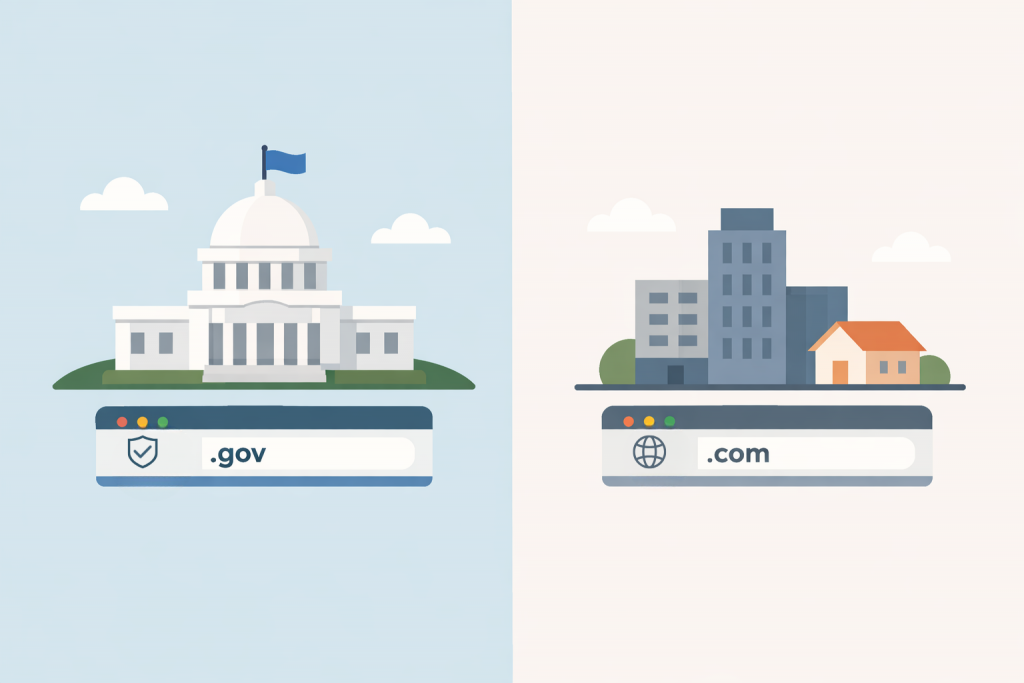
When a user sees the address of a government authority in the browser bar, the level of expectations automatically increases. This is not just a link, but a marker of official status and verified data. Behind this perception is not psychology, but a very specific logic of administration and strict filters at the registration stage.
Government domains exist in the same DNS space as familiar .com or .net, yet they operate like closed clubs. While regular zones are open to the mass market, government segments remain reserved exclusively for authorities and related institutions.
Mechanics of access
Unlike commercial names that can be purchased in a few clicks with a bank card, registration in government zones always involves pre-moderation. Each country builds its own vertical of control.
In Ukraine, this is the .gov.ua zone. To delegate such a name, an organization must document its status. This makes it impossible for private individuals or third-party companies to capture similar names. A similar approach can be seen in the United States with the .gov zone: registration there goes through a multi-level verification by federal services. The key barrier here is not technological, but administrative.
Why registration data becomes a news trigger
Limited access to such zones creates increased attention to any movements in the registries. Since there are no random participants, every new name is perceived as an official announcement or preparation for a government initiative.
Recently, records appeared in registries for the domains aliens.gov and alien.gov. Both were created in the .gov zone, which a priori excludes someone’s joke or a private project. Technical details indicate that one of them was registered on March 17, 2026. It received the status serverTransferProhibited, which blocks the ability to transfer it to another registrar, and uses Cloudflare DNS servers.
Despite the fact that these addresses are currently empty, the very appearance of such names in a government zone triggered a wave of discussions. This illustrates the main feature: in the .gov segment, a name starts working for reputation even before the first file is uploaded to the server.
Technical base and infrastructure questions
If you break down a domain at the protocol level, there is no difference between a government and a commercial resource. They use identical DNS mechanisms to convert a text record into an IP address.
The same types of records, similar servers, and standard security protocols. Government structures also use modern content delivery networks (CDN) to optimize traffic and protect against attacks. The example of using Cloudflare for official U.S. domains only confirms that, infrastructurally, these zones are not isolated islands. The difference lies only in ownership rights and the level of trust in the owner.
Domain as a communication tool
Trust in .gov is built not on complex encryption, but on the understanding that a fraudster will not pass verification. The user subconsciously filters information depending on the zone.
For regular online projects, this is an important lesson. While businesses do not have access to government zones, the principles of naming and choosing an extension remain critical. A domain is the first point of contact. Short and logical names work for recognition, while strange or overly complex constructions make a visitor hesitate. Cases from government registries show: choosing a name is a full-fledged part of a promotion strategy that begins to shape the perception of a project long before the official launch.
Leave a Reply