

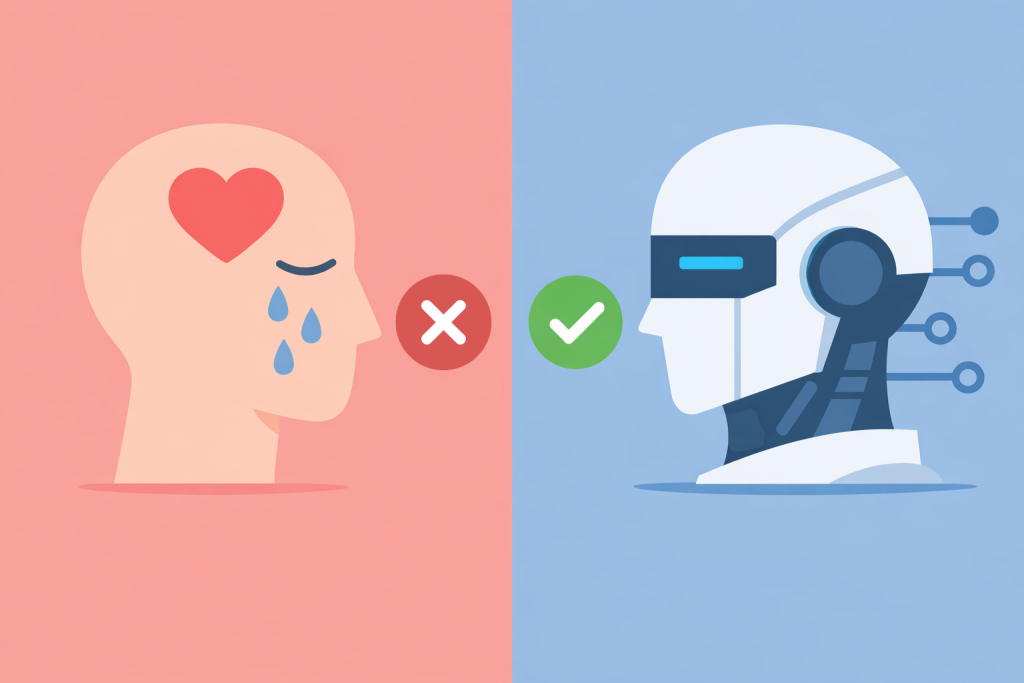
Not so long ago, the main measure of a neural network’s quality was considered its ability to imitate a human. Polite courtesies, extended introductions, and soft phrasing created the illusion of a live interlocutor. At the stage of getting familiar with the technology, this helped remove the barrier of distrust, but over time the priorities shifted.
Practice has shown that excessive “humanity” often becomes an obstacle. When a specialist needs a specific answer to a technical question, extra words only blur the essence. Instead of immediately taking a solution into work, one has to push through layers of text that carry no meaningful load. AI began to “talk” too much where functional tool behavior was expected from it.
Where emotionality turns into ballast
The problem is not in the style itself, but in its appropriateness. Many models tend to overuse warnings and lengthy descriptions of context before getting to the point. On the scale of a single request it looks like a minor thing, but in a working cycle where there are hundreds of such iterations, a noticeable time delay appears.
This is felt especially sharply in system administration or development. For example, when diagnosing server errors or writing scripts, it is critically important to receive an exact command without “lyrical digressions.” When the algorithm starts apologizing for possible inconveniences or describing obvious things in detail, the user spends valuable time filtering out noise.
The resource side of the issue
Behind every generated word there are real computing resources. In a professional environment, text is measured in tokens – units that the processor handles. The more voluminous the response, the higher the load on infrastructure and the longer the wait for the result.
Extra polite constructions are not just a matter of aesthetics, but additional computation cycles on servers. In systems with thousands of simultaneous sessions, the difference in response length directly affects platform stability. For providers of cloud solutions or VPS hosting, the efficiency of resource usage is a key factor that determines the speed of service for the end client. A shorter response means faster delivery and more rational consumption of power.
A shift in model development direction
Developers have already responded to this market demand, which is confirmed by the recent release of GPT-5.3 Instant from OpenAI. New model iterations demonstrate a clear shift toward pragmatism: the focus has moved from “pleasant communication” to delivering results. Neural networks now use templated introductions and moralizing preambles less often, moving more confidently to the essence of the request. Unlike previous versions that tried to carefully explain their safety boundaries, GPT-5.3 Instant immediately focuses on user intent, which minimizes the number of “dead ends” in dialogue.
Along with conciseness, accuracy has also increased. The number of cases where AI “hallucinates” has significantly decreased – in critical domains such as medicine or law, the error rate has dropped by about a quarter (26.8% when using the network). Models have become better at reading subtext: they bring the most important information to the forefront, discarding the secondary. This makes the obtained data relevant and immediately usable in work, without unnecessary warnings and without loss of speed.
Pragmatism as a new convenience
Rejecting the imitation of emotions does not make interaction with AI worse. On the contrary, the absence of informational noise makes perception easier. The technology is finally moving into the category of a working tool, from which not conversational support is expected, but problem solving.
In scenarios where response speed is critical – from process automation to handling large volumes of data – every extra operation has a cost. Even stylistically pleasant text can be harmful if it carries no practical value.
Of course, in customer support or education, a softer style of presentation remains relevant because it helps explain complex concepts more easily. However, the overall trend is clear: AI is becoming more restrained and more direct. This is not a degradation of style, but its optimization. Fewer words – more focus on results, which benefits both the user and the system that delivers that result.
Leave a Reply