

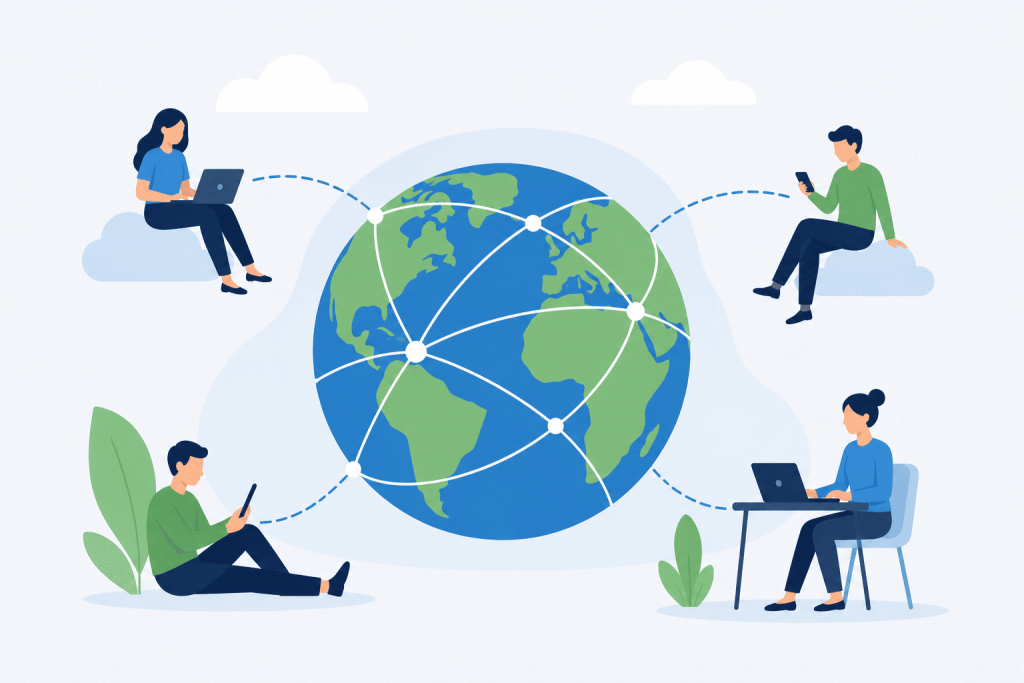
May 17 is marked on the calendar as two closely related occasions: World Telecommunication and Information Society Day and Internet Day. This date is tied to the year 1865, when the International Telecommunication Union was founded. Back then, rules for international telegraph communication were being developed. Later, Morse devices were replaced by telephone lines, then mobile communication, satellites, and fiber optics appeared. Now information can be transmitted across distances in milliseconds.
Today it is difficult to adequately grasp the scale of this influence. What twenty years ago required separate devices, hardware, or visits to institutions is now packed into a single screen. A smartphone has replaced a bank branch, a navigation map, mail, and a workplace. We interact with the global network hundreds of times a day without even noticing it.
When the Internet Became Background
The biggest transformation is that the internet stopped being an event. Earlier, “going online” meant setting aside time, listening to the modem screech, and waiting for a single page to load. Now the connection works by default. People remember the network only when the signal disappears.
Everything goes through online channels: from buying groceries to obtaining government documents and controlling household appliances. Smart devices download updates themselves at night through Wi-Fi and do not require the user’s attention.
At the same time, the internal mechanics remain hidden. Behind every click stands the work of DNS – a system that translates website names understandable to us into the language of network addresses. Without this “phone book,” the browser simply would not know which server contains the required page.
Another familiar element is the SSL certificate. It is the same green or gray lock in the address bar. It shows that the connection is secure, data is encrypted during transmission, and passwords or card numbers will not travel openly through a provider or public Wi-Fi.
The Reality of the Information Society
Behind the academic wording “information society” there is a simple dependence on speed. In the past, the economy relied on factories and raw materials; now processes are tied to data processing.
Businesses have massively moved into the cloud. Instead of storing accounting software or archives on office servers, companies use the capacity of remote data centers. This allows teams to work on projects from any location where there is a network connection.
The very concept of online presence has also become more complicated. It is no longer enough to simply make a business card website. It is necessary to choose a proper domain, configure corporate email, provide encryption, establish daily backups, and connect communication in social networks.
The internet has transformed from a tool into a living environment. That is why May 17 is no longer really about professional communication or wires, but about the space where we spend most of the day.
Leave a Reply