

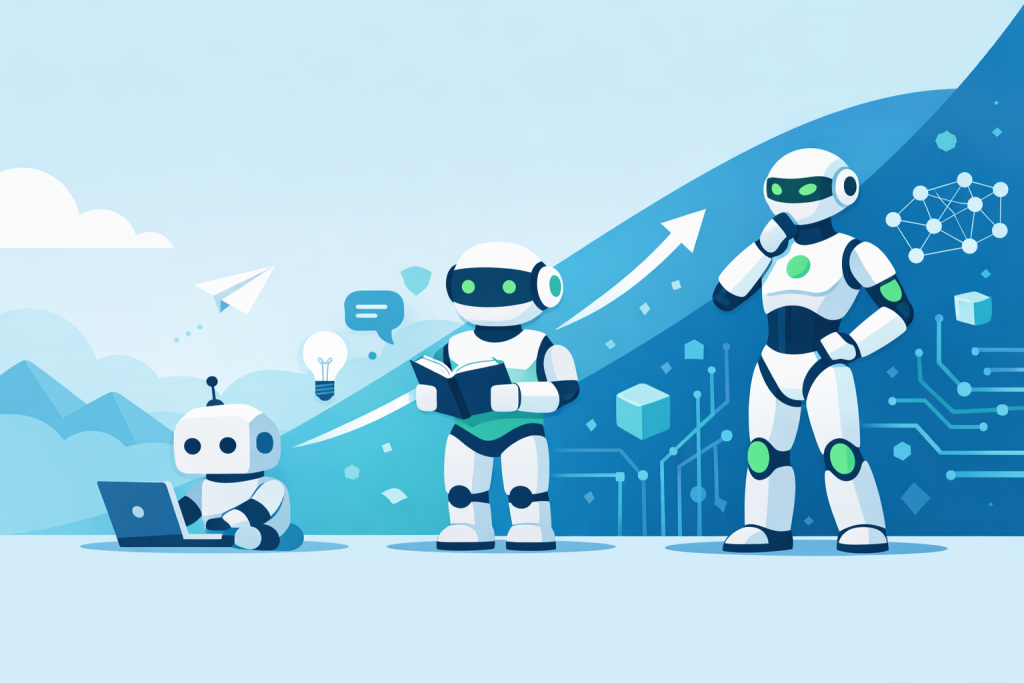
When ChatGPT appeared at the end of 2022, it was perceived more as a technological experiment. A simple chat capable of answering questions, explaining terms, and writing texts quickly attracted the attention of developers, copywriters, and technical specialists. But even then it was clear that this was only the first step. In a relatively short time, ChatGPT went from demonstrating the capabilities of artificial intelligence to becoming a full-fledged digital tool used by millions of people in their daily work.
The Beginning of the Evolution and the Role of the Conversational Interface
The first versions of ChatGPT were built around the idea of a live dialogue between a human and AI. The key advantage was the ability to ask questions in plain language without technical commands or complex instructions. This made the technology accessible not only to specialists but also to a broad audience. At this stage, ChatGPT acted as a universal assistant for explanations, texts, translations, and basic consultations.
At the same time, the model’s capabilities were limited. The context of requests was short, complex logical tasks produced unstable results, and access to the service often depended on server load. Nevertheless, this stage laid the foundation for further development.
Expansion of Functions and the Transition to Practical Use
The next stage of evolution was associated with the expansion of tools. ChatGPT began working with files, analyzing data, generating images, and retaining conversational context more effectively. Artificial intelligence ceased to be just a source of answers and gradually turned into a working environment that helps accomplish specific tasks.
It was at this point that ChatGPT started to be actively used in business, education, marketing, development, and analytics. It became part of processes where speed of information processing, precision of wording, and the ability to adapt to different scenarios are critical.
The Emergence of Pricing Plans as a Logical Stage of Development
As the number of users grew, it became clear that a single universal level of access no longer existed. Some users need only basic capabilities, while others work with ChatGPT every day and require stability, higher limits, and extended functionality. This led to the introduction of a pricing system that made it possible to adapt the service to different needs.
The free plan remained an entry point for getting acquainted with the technology. Paid plans began to offer more resources, better performance, and access to more advanced models. This became an important step in transforming ChatGPT from an experimental product into a large-scale commercial service.
ChatGPT Go as a Response to Mass Demand
The ChatGPT Go plan emerged as a response to a typical issue with free access: it is sufficient for getting familiar with the service, but it quickly begins to limit users in real work. In the free version of ChatGPT, limits on the number of messages occur more often, restrictions apply during peak hours, and access is limited to basic features. For occasional use this is enough, but for daily tasks such limitations become noticeable.
ChatGPT Go removes these bottlenecks. Users receive higher dialogue limits and more stable access to the service, allowing them to work without constant interruptions. Responses are generated faster and more consistently, and the model retains the context of longer conversations more effectively. This is especially noticeable when working with large texts, complex queries, or series of interconnected questions.
Another key difference is access to extended features that are either unavailable or heavily restricted in the free mode. This primarily includes working with files, document analysis, and more flexible interaction with data. For users, this means that ChatGPT can be used not only as a chat for advice, but as a tool for real tasks: preparing materials, analyzing information, or assisting in learning.
At the same time, ChatGPT Go does not aim to replace professional plans. It is not designed for maximum workloads or highly specialized scenarios, but it provides a noticeably higher level of comfort and stability compared to the free version. That is why this plan has become a logical choice for those who already actively use ChatGPT but do not require a full professional feature set.
ChatGPT as Part of Digital Infrastructure
Today, ChatGPT is increasingly seen not as a standalone service but as an element of a broader digital ecosystem. Its effectiveness directly depends on stable server infrastructure, computing resources, and fast data transmission channels. Reliable servers enable AI services to operate without delays, process large volumes of requests, and scale alongside audience growth.
High-quality server infrastructure becomes the foundation for all modern AI tools. Without powerful servers, sufficient amounts of RAM, and stable connectivity, even the most advanced models cannot function effectively. Therefore, the development of services like ChatGPT is closely linked to the development of server solutions and data centers that support their operation.
Leave a Reply